The Story of John (Ian) Robert Pollock and the crew of MZ304
The night of November 25, 1944
An excellent tribute and memorial by Flying Officer Pollock's cousin, Bruce Pollock. MZ304 crashed in 1944, but Bruce Pollock through research, as well as old eye witness reports has managed to put together a history of that last flight. A well researched article and fascinating read.
The Story
Flying Officer John Robert Pollock
d: November 25, 1944
To the Air Force, he was F/O Pollock J. R. J38253. His name was John Robert Pollock, but 'Ian' is the Scots Gaelic version of 'John' and that's what the family called him.
Jack Pollock, his father, had served in the First World War with the 143rd Regiment, known as the “BC Bantams”. He was only 5’ 2½” in height which was not tall enough to join the regular army, but he was a carpenter and joined the regiment which took on men who had something to offer the war effort in spite of their height. Jack went overseas with the Regiment and worked in railcar repair in France during the War. After the war, Jack and Margot had married in October 1919 and moved to Union Bay on Vancouver Island where Jack worked as a carpenter for the Cumberland Coal Company. John (Ian) Robert Pollock was born February 3, 1924 in Union Bay BC, the son and only child of John Pollock and Margaret Patterson.
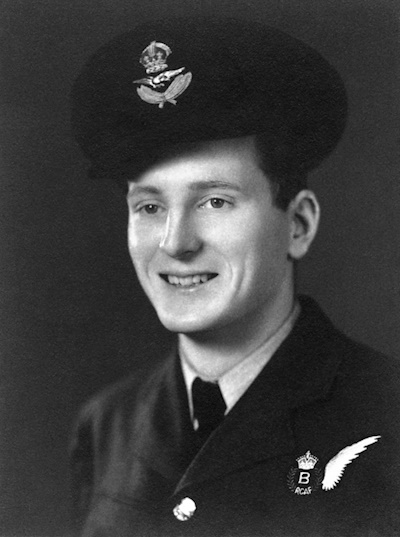
Ian Pollock after graduating with his wings in 1943.
Ian was 18 years old when he joined the Royal Canadian Air Force in October 1942 and entered the British Commonwealth Air Training Plan (BCATP). After four or five weeks of basic training at the Manning Depot, in early July 1943 Leading Aircraftman (LAC) Pollock was sent to No. 7 Initial Training School (ITS) in Saskatoon SK as an Air Observer (Navigator) candidate.
He spent the summer of 1943 learning bombing, gunnery and navigation, flying in Bristol Bolingbroke and Avro Anson aircraft. By mid-November 1943, he had completed further training at the No. 7 Air Observer School in Portage la Prairie, MB.
The BCATP was to become one of Canada’s greatest contributions to the war effort. It was created in 1939 by agreement of Britain, Canada and other Commonwealth countries. There were training operations in Australia, Bermuda, New Zealand, Southern Rhodesia and South Africa. But Canada’s location, safety and wide prairie skies made it the centre of the program. Under the agreement, Canada was to pay the majority of its cost, and Prime Minister Mackenzie King hoped this would reduce Britain’s demand for a large land army contribution, thus saving Canadian lives.
The Canadian government also fought hard to have the RCAF recognized by Britain as a standalone force under Canadian command, similar to the USAF. But Britain refused and the government had to settle for the creation of No. 6 (Bomber) Group made up of 14 wholly Canadian squadrons under the command of the RAF. In the spring of 1944, Ian was sent to Britain to complete the third stage of his training closer to the operational front. He started in Northern Ireland at No. 7 Advanced Flying Unit at RAF Bishop’s Court near Belfast.
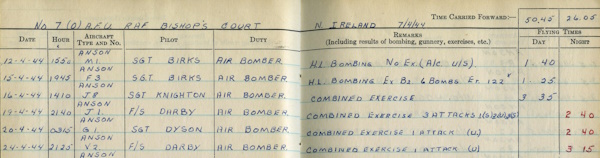
Excerpt from Ian's flight log book showing training activity with No. 7 AFU, Bishop's Court
In between flight training days at Bishop's Court, he wrote an air letter home to his parents. He mentions the mails and says “Yesterday, we had an officer from the Base Post Office here and he said our mail would be slow because recently they had a very large mail and they were having a time getting it sorted.”
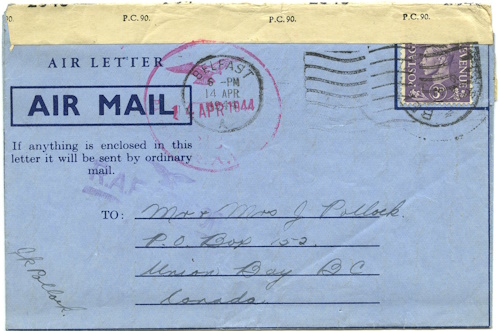
Air letter from Ian to his parents, postmarked Bishop's Court, April 14, 1944.
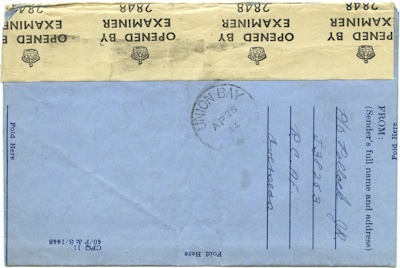
As an officer, Ian was allowed to self-certify that the contents of the letter contained no classified information (signature in lower left corner). Enlisted men were required to have their mail reviewed and approved by an officer. To the right, the reverse side of air letter showing censor tape which was applied after it had been read, approved and re-sealed by regional censors.
In early June 1944, Ian was posted to the No. 82 Operational Training Unit, the fourth and final component of his training before joining an operational squadron. On June 8, he flew with pilot Flying Officer James T. Hardy for the first time in a Vickers Wellington aircraft. This would be his first experience in a ‘real’ bomber, although by this point in the war, the older, smaller, twin-engine ‘Wimpy’ had been supplanted by the Handley Page Halifax and Avro Lancaster heavy bombers. After spending June and July practicing circuits and bombing runs in the Wellington, the crew graduated to the Halifax in August.
The BCATP had been so successful that by this time in the summer of 1944, there was actually a surplus of trained air crew. The irony is that more than half the 131,553 graduates were Canadian, thus Mackenzie King’s objective of saving Canadian lives somewhat failed.
In early September 1944, Ian and the rest of F/Lt Hardy’s crew finally completed their training and were assigned to 427 Squadron RCAF (the ‘Lion Squadron’) at Leeming, Yorkshire. The Lions were flying Halifax Mk. III aircraft.
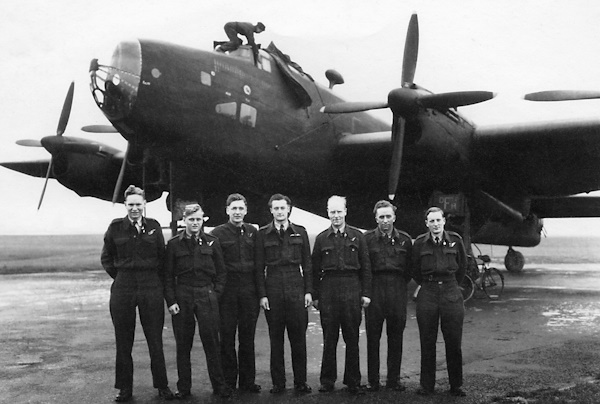
Flight crew posing in front of Halifax at Leeming. F/Lt J. T. Hardy is in the centre and Ian Pollock is standing far right.
Ian took off on his first operational mission at 1600 hrs on September 14 to attack Wilhelmshavn on the North Sea coast of Germany, but the mission was scrubbed about an hour after takeoff and the group was recalled.
The next day, 11 aircraft from 427 Squadron took off at 2145 hrs to bomb Kiel. They encountered heavy flak over the target but it was below their flight altitude. All aircraft returned to Leeming at 0400 hrs, September 16. Ian had completed his first bombing mission.
On September 17 at 0700 hrs, 16 aircraft from 427 Squadron took off for Boulogne, France. F/LT Hardy and his crew were flying ZL-G and Ian released 4x 500 lb. and 9x 1000 lb. bombs.
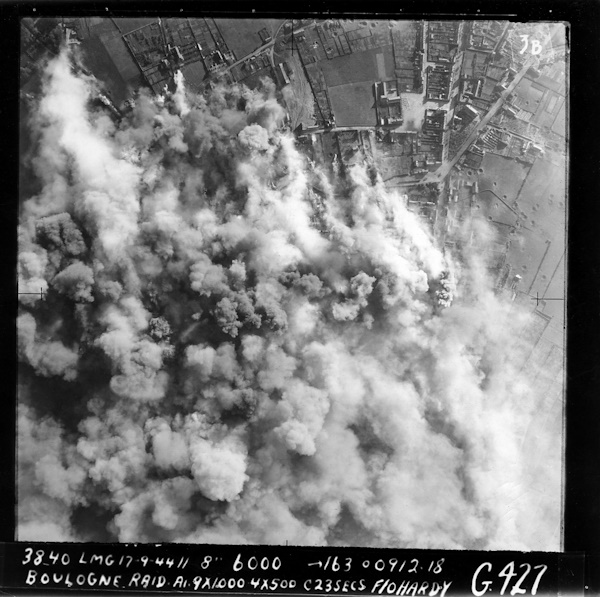
Actual photograph from Ian's bomb aiming camera taken during the September 17, 1944 raid on Boulogne.
On the night of November 25, 1944, five aircraft from 427 Squadron took off from Leeming on a ‘gardening’ mission near Anholt Island (code-named YENTREE) in the waters of the Kattegat between Denmark and Sweden. ‘Gardening’ was an airborne mine-laying operation over the sea. The Kattegat was a major route for German naval traffic between the Baltic Sea and the North Sea and thus, an area of major focus for the Allies. The mission group included F/Lt Hardy, Ian, and the crew of ZL-H (MZ304).
The 427 Squadron War Diary describes the operation:
Weather [over the target] was 10/10ths cloud with bases at 800/1000 ft. with good visibility below cloud. Crews report that their approach was evidently undetected as when the first aircraft arrived, the town and harbour were lit up and the airfield obligingly turned on its lights for them to land. Ten minutes later light flak opened up on the island. Considerable shipping lights were seen in harbour and vicinity. No fighters seen. All crews attempted photographs.
Likely due to the poor weather, the squadron diary records that all five returning aircraft diverted to northern Scotland to land. Four landed safely, but MZ304 piloted by F/Lt Hardy landed in the sea a few hundred yards off Kingston, Morayshire at the mouth of the River Spey. It exploded on contact with the water, killing all aboard.
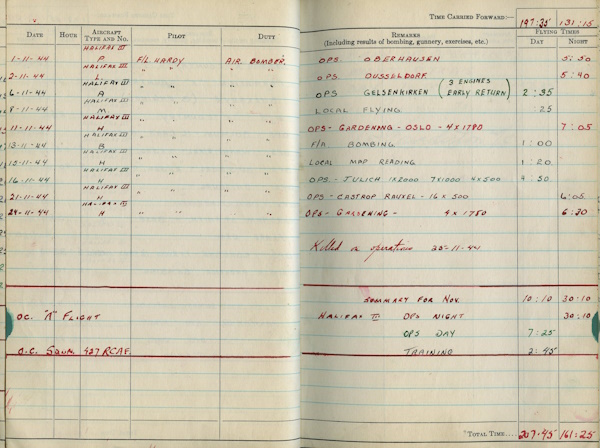
Final entry in Ian's flight log book.
While the precise series of events will never be known with certainty, we have a pretty good idea from a letter written by a family friend to Jack and Margaret. In February 1945, about three months after the fatal crash, G. H. Watt who was stationed with the Canadian army in Britain, used some of his leave to travel to Banff, Aberdeenshire to try to get more details.
Watt interviewed the Commanding Officer of the Coast Guard station whose crews had responded to the crash. He also interviewed his niece's husband, Mr Houston, who apparently was also a member of 427 Squadron (perhaps ground crew?). Watt specifically says that the air force has not been helpful in explaining what happened to the aircraft that night.
In his words, upon reaching Scotland:
They...circled over 3 airfields [most likely RAF Dallachy, RAF Kinloss and RAF Milltown which were all close together], two of which had their landing beacons on and although there was a snowfall at the time the plane could be seen from the ground, and then headed out to sea again, but a coast guard saw them drop a flare while still over land and as soon as the plane touched the water it blew up and although it only took the coast guard 10 minutes to get to the scene, the first body had already washed ashore.
The coast guard officer summed the accident up in these words.
...that there was something wrong with the landing gear of the plane and that the pilot must have figured that it would be safer to land on the water and that when they did the plane hit a mine. As there had been enemy activity on that coast from time to time the coast was very heavily mined. My niece's husband told me that they had all been wondering what had happened to the plane as the skipper was very careful and not prone to take chances.
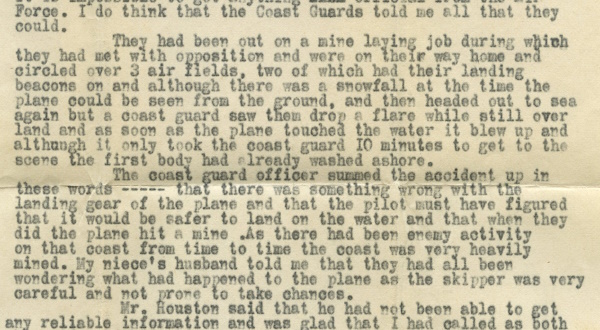
Excerpt from letter to Ian's parents from G. H. Watt regarding the events of the crash.
The 427 Squadron War Diary entry for the mission also states that "two aircraft successfully dropped their mines, and two brought them back." Of course, this only accounts for the four aircraft which returned safely from the mission and not MZ304. But it seems unlikely that a pilot would attempt to ditch his aircraft in the sea with a load of mines still on board.
John (Ian) Robert Pollock was 20 years old and had flown 21 operational missions in a brief period of less than three months from September to November 1944.
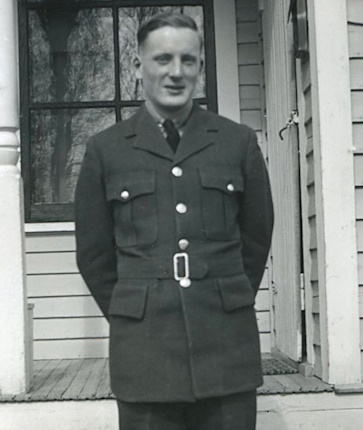
Ian Pollock on the steps of his Union Bay home, just after joining the RCAF in 1942.
Mount Pollock in Clendinning Provincial Park in British Columbia's Coast Range Mountains is named for Ian Pollock. It is located across Georgia Strait from Union Bay where Ian was born.
Five of the seven crew members are buried in Bellie Churchyard near Fochabers, Scotland. F/O Hall is buried at Chigwell, Essex and F/Sgt Rowntree is buried at Preston Cemetery, Tynemouth. Also buried alongside the crew of MZ304 is F/O S. D. Easterbrook, RAAF, who died the previous week on November 18, 1944.
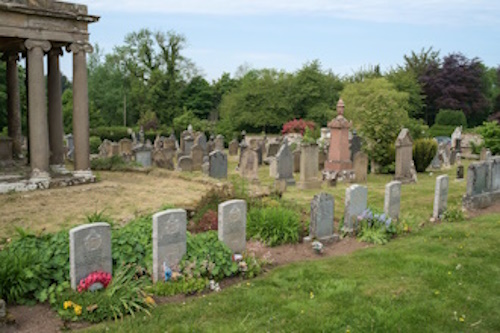
Gravestone, Bellie Churchyard near Fochabers, Scotland, May 2024.
The crew of MZ304:
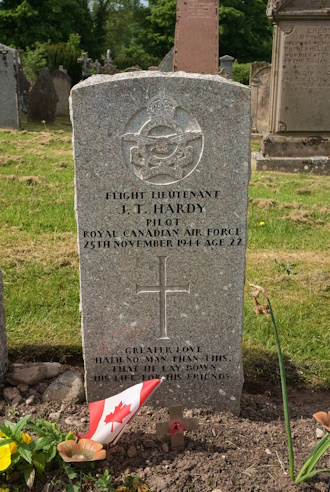
Flight Lieutenant James Thomas Hardy (Pilot), Merritt, British Columbia.
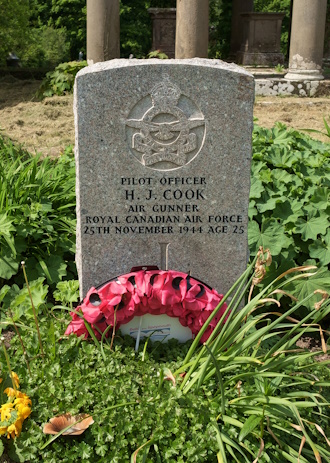
Pilot Officer Howard John Cook (Air Gunner), Hillmond, Saskatchewan.
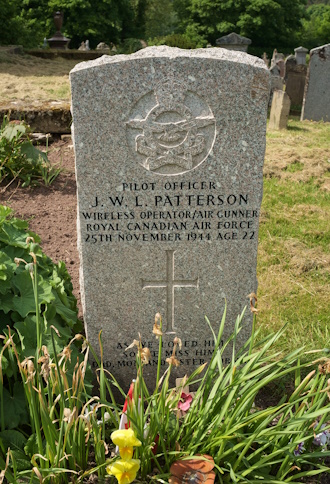
Pilot Officer John William Lyle Patterson (Wireless Operator), La Riviere, Manitoba.
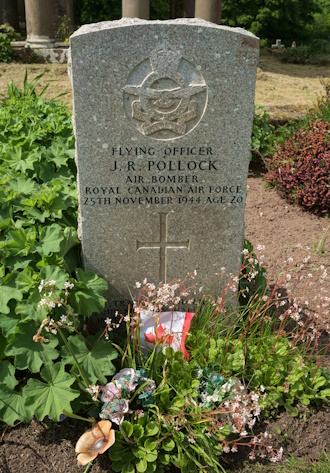
Flying Officer John Robert Pollock (Bomb Aimer), Union Bay, British Columbia.
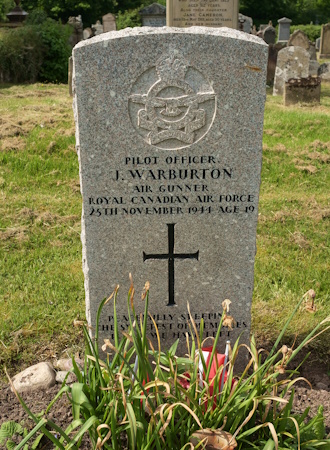
Pilot Officer John Warburton (Air Gunner), Toronto, Ontario.
Flying Officer Stanley George Hall (Navigator), Shaunavon, Saskatchewan.
Buried at Chigwell, Essex, England
Flight Sergeant Matthew Rowntree (Flight Engineer, RAF) Tynemouth, England.
Buried at Preston Cemetary, Tynemouth, Tyne and Wear, England
Sources:
Personal Log Book and photographs of F/O Pollock J. R. J38253, RCAF
Wikipedia sourced for the history of the BCATP
The Friends of Bellie Churchyard.https://fobcy.org.uk/
427 Squadron Association War Time Log Monthly Operations. https://www.427squadron.com/history/wartime_logs/ops_logs_month_total.html